

The struggle is real: Companies are facing an increase in support demand while trying to keep pace with current demand. Self-help initiatives and automation form a cornerstone for scaling support. This article introduces the approach companies use to scale support with self-help resources and automated tools.
Self-Help defined
“Self-help” describes the strategies used to deliver customer support assistance though knowledge sharing, process automation and automated issue resolution. Self-help implies that the tools and resources provided to answer customer questions do not require any direct interaction or involvement by Support staff.
Self-Service tech support via self-help resources
According to research by ServiceXRG, providing customers with access to self-help resources is the most common effort companies use to scale the delivery capabilities of Customer Support. Companies are most likely to offer access to a searchable knowledge base; self-paced training and documentation; troubleshooting and best practices guides; and software patches, hotfixes, and updates. See the full list below.
Self-Help Resources Provided
-
Searchable knowledge base
-
Self-paced learning
-
Troubleshooting and best practices guides
-
Templates and examples
-
Product documentation
-
Updates and patches
-
User dashboard with alerts and recommendations
-
Proactive content push to customers
-
Federated search across website
Source: ServiceXRG State of Support 2023
Automation a key to self-help success
Self-help is not the only approach companies use to reduce the burden on Support staff. Both self-help and automation can resolve cases before they are created or provide the means to streamline support case management activities.
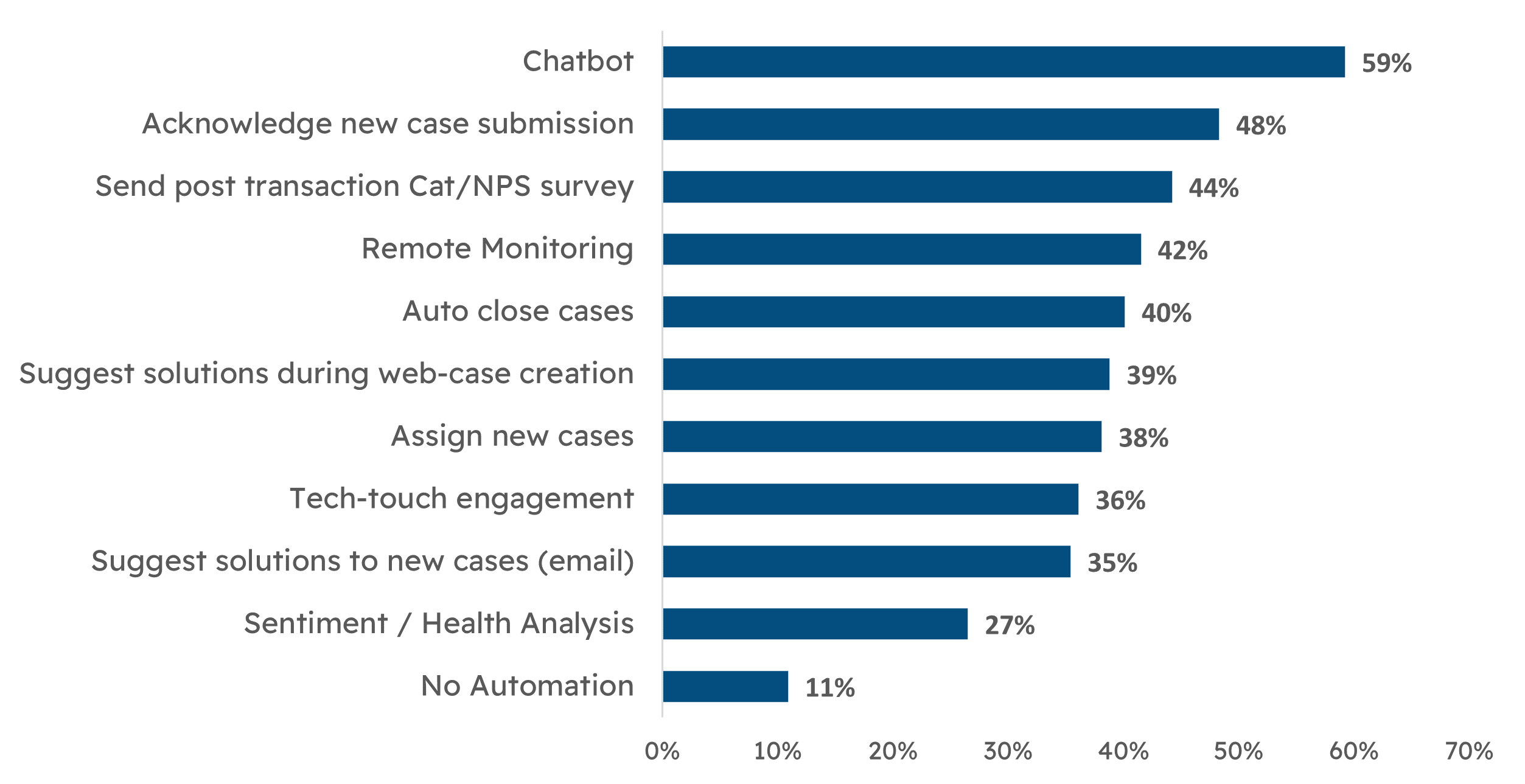
ServiceXRG’s research shows that automation plays an increasingly important role in streamlining support case management activities. When automated, simple, repetitive, yet important tasks such as sending follow-up transaction surveys, notifying customers when a case is closed, or acknowledging receipt of a new case can enhance the customer experience without requiring extra time and effort by Support staff. Automation can also be highly effective for routing cases to the most qualified individuals or team for prioritized resolution. See chart below.
Our research also tells us that more sophisticated automation, such as matching and suggesting solutions to customers as cases are created (web form) or received (e-mail) can help to deflect the need for support assistance. Additionally, the ability to automatically route new cases to the best qualified individual or team can also help to expedite resolution.
Companies are also introducing intelligent automation into case flow processes to help discover, refine, and resolve customer issues through chatbots, or identify cases that can be automatically closed.
Service Automation Used
Multiple responses allowed
Self-help and automation: wide use, but low impact
Although Self-help is used widely across the industry, only 20% of companies cite it as a primary factor for reducing support demand.
This suggests that even when self-help is offered, overall support demand does not decline, although the percent of support demand handled by support staff is likely to be reduced. This is not to suggest that self-help is not worthwhile. It cannot, however, be the only investment Support organizations make to reduce demand.
For Support organizations to scale to meet new demand and take on high-value customer engagement activities, companies will need to look beyond just self-help initiatives and increase their focus and investment on issue prevention, accelerated adoption of automation, and building customer proficiency.