


ServiceXRG
  • Your Challenges
    • Overview
    • Strategic Support Assessment
  • Our Solution
    • Overview
    • Achieve Strategic Support
    • Our Process
    • Strategic Support Framework
    • Membership
  • Why ServiceXRG
    • Overview
    • Capabilities
    • Clients
    • Team
  • Resources
    • Resource Library
    • Blog
    • Support Leadership, Unfiltered
  • Member Login
ServiceXRG
  • Member Login
  • Strategic Support Assessment
  • Let’s Talk
  • Your Challenges
    • Overview
    • Strategic Support Assessment
  • Our Solution
    • Overview
    • Achieve Strategic Support
    • Our Process
    • Strategic Support Framework
    • Membership
  • Why ServiceXRG
    • Overview
    • Capabilities
    • Clients
    • Team
  • Resources
    • Resource Library
    • Blog
    • Support Leadership, Unfiltered

Blog : How Much Should You Charge for Support?

  • Previous Post
  • All Posts
  • Next Post

How Much Should You Charge for Support?

By Tom Sweeny May 28, 2021

How much should you charge for Support?  It’s a driving question as your organization seeks to drive recurring revenue growth. And it’s a balancing act.

Setting the correct price for your Support programs begins with a baseline understanding of what your market will bear. Ultimately, though, you must base your pricing on the type and level and entitlements you offer.

Let’s explore a Support pricing model that’s been shown to work equally well for businesses and their customers.

Calculating Average Support Program Price

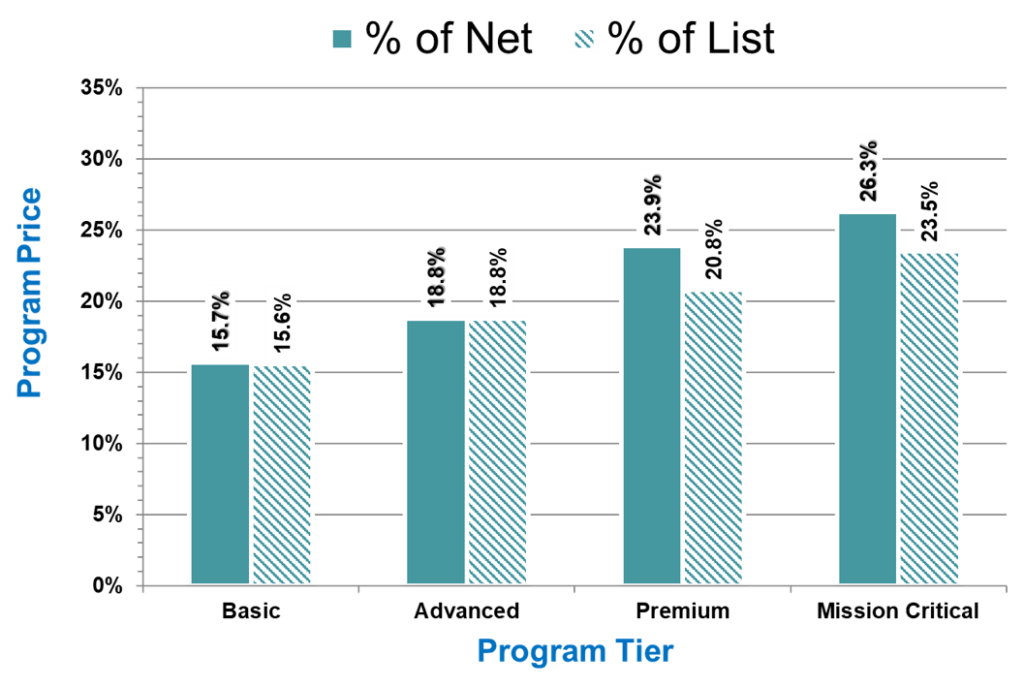
The average prices for Support programs range from 15.6 percent for a basic level of support to more than 26 percent for a high-end premium program.  Prices vary based on the entitlements offered and the ways that pricing is structured.  Here are a few considerations:

Net vs. List

Pricing may be based on a percentage of either a product’s list price or its net price after discounts.

Add-ons and Fixed Fees

Some Support programs consists of a fee tied to a percentage of either product list or net price plus add-ons.  Add-ons are often associated with optional entitlements such as named support resources (i.e., designated support engineers and/or account managers).

Adjustment Fees

The price of support in the first year is often not the price a customer will pay in subsequent years.  Support prices typically include annual adjustment fees to account for inflationary factors.

Pricing by Support Program Tiers

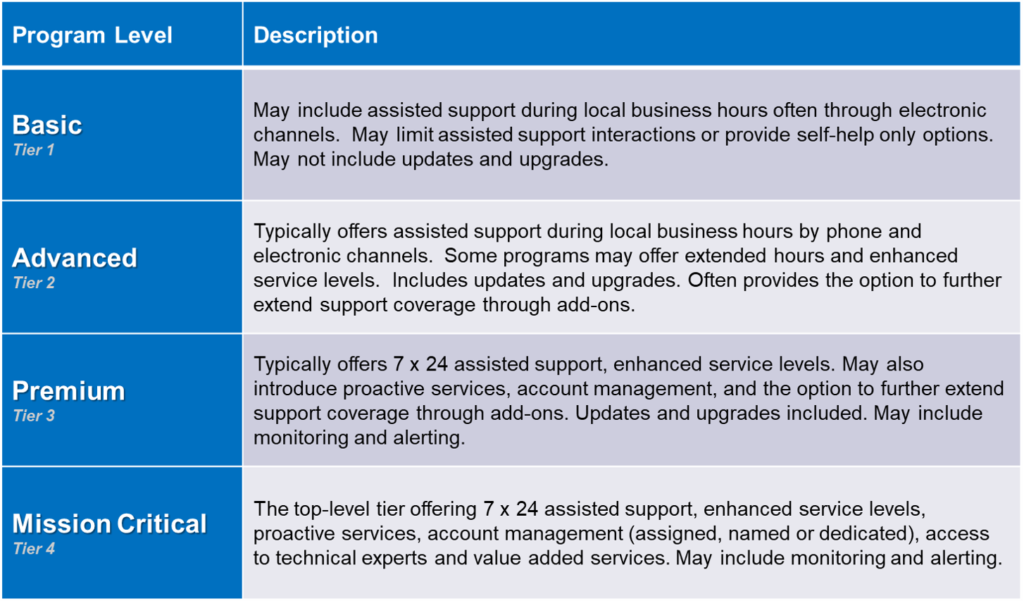
Support pricing is typically established by program level or tier.  It is not uncommon for support portfolios to consist of two or more tiers with names like Silver, Gold and Platinum.  Although support programs may sound alike, they often vary from vendor to vendor.  For the purposes of establishing baseline pricing benchmarks ServiceXRG has normalized support programs into the four distinct tiers described below.  Classification is based on the underlying program entitlements and not on the program names.

Support Program Tier Classifications
Average Support Program Price
Establishing Support Prices

The price of Support must be set at a level sufficient to cover delivery costs, yet not too high to discourage customers from buying.   Customers are likely to have preconceived ideas about how much (or how little) Support should cost based on their experiences with other technology vendors.  If your “gold” support is priced at 23% of product list price but other vendors price that level at 18%, customers may perceive that your prices are too high — even if you offer more for the price.

It is imperative that you price Support reasonably so that you can make a compelling case that the benefits outweigh the costs to the customer.

Making the Case for Services

Selling services demands that you establish a credible and compelling value proposition built upon the entitlements customers want and need from services balanced with a reasonable and justifiable price level.


Service Portfolio Design

Build service offerings that support subscription success.

This report explores best practices for designing service portfolios that drive customer outcomes, renewals, and expansion.

This report shows how modern service portfolios must evolve to support customer success and recurring revenue.

Download Now

NextGen Support Metrics for 2026 & Beyond

Activity metrics don’t explain value.

Adopt a strategic measurement model that connects support performance to customer outcomes, business impact, and smarter investment decisions—across seven critical focus areas.

Download the report to adopt metrics built to prove support’s strategic value.

Get a Copy
  • Previous Post
  • All Posts
  • Next Post

Subscribe for even more resources and the latest in your inbox.

"*" indicates required fields

This field is for validation purposes and should be left unchanged.
Name*

By clicking the "Submit" button you accept and agree to be bound by the Terms of Use and Privacy Policy.

Related Posts

  • 2.13.26 Read Time: 3 Mins

    AI’s Promise, Leadership’s Test

    As AI adoption accelerates, some organizations will choose to use AI to elevate support’s strategic relevance, while others will automate activity without improving outcomes. Here’s what makes the difference.

  • Read Time: 3 Mins

    Choosing the Battles That Build Leadership Credibility

    Strategic support leaders choose moments where support’s perspective can materially improve outcomes the business already cares about. Here’s how to know which battles to fight.

  • Read Time: 4 Mins

    From Reactive Support to Strategic Relevance: A Leadership Journey

    Where is your support organization on the journey from reactive containment to strategic relevance? Here’s the roadmap—and how to recognize which stage you’re in.

ServiceXRG

© Service Excellence Research Group, LLC 2026. All Rights Reserved.

Website by Imagebox

Contact Info
  • Email: info@servicexrg.com
  • Phone: 800-475-0089
Social Media
  • LinkedIn
  • Newsletter
  • Twitter