


Customer experience isn’t just about delivering good service—it’s about driving measurable business outcomes. Yet many companies fall into the trap of executing CX activities without aligning them to strategic objectives.
The result?
A drag on growth due to increased churn, down-sell, weakened customer relationships, and missed revenue opportunities.
Ask yourself:
- Are our CX efforts clearly aligned with both customer and business outcomes?
- Do we have executive leadership and strategic direction guiding CX?
- Are we measuring impact—or just tracking activity?
- Are we adapting as customer needs and expectations evolve?
If the answer to any of these is “no” or “not sure,” your CX may be underperforming—even if your teams are busy and tactical execution appears to be on track.
A Strategic Framework: Four Types of CX
This quadrant-based model helps companies assess how well their CX efforts are aligned with business strategy—and how effectively they’re driving growth, retention, and loyalty.
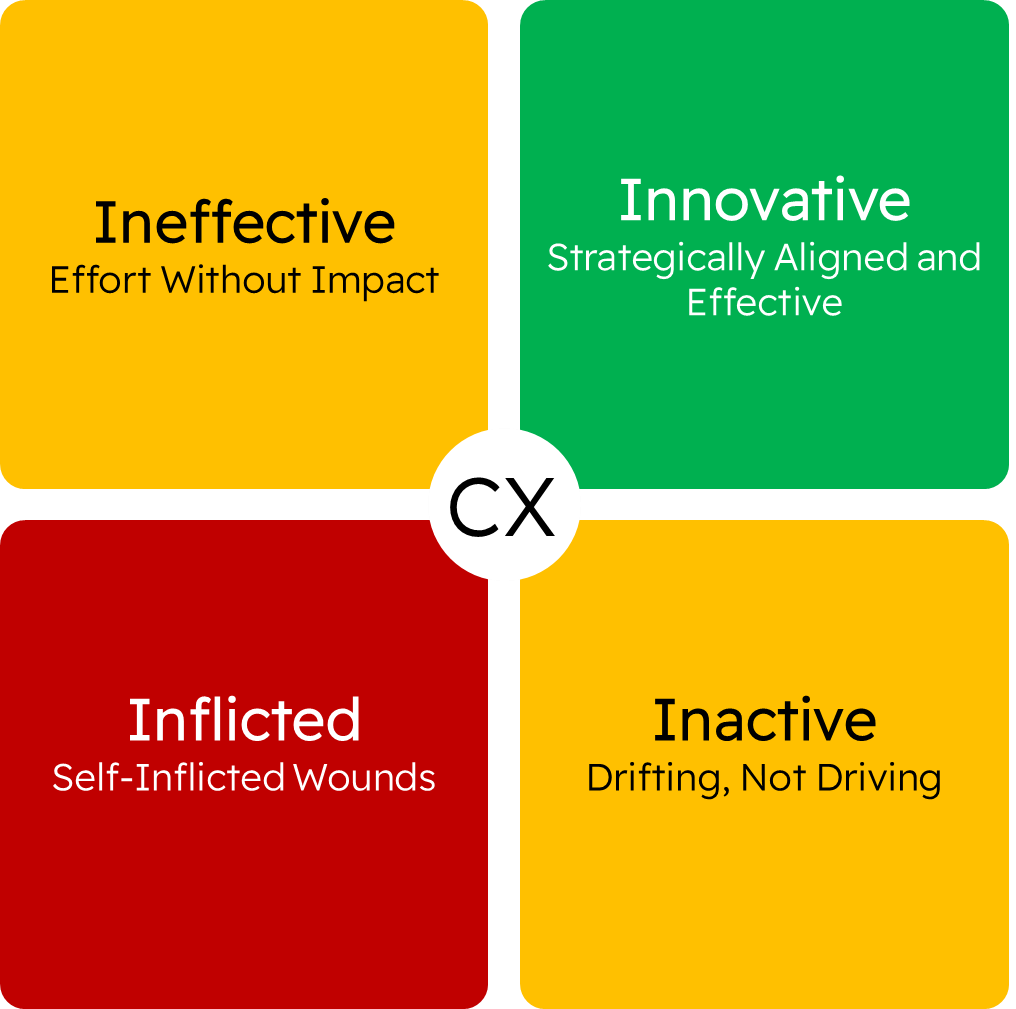
Innovative CX: Strategically Aligned and Effective
Definition:
Innovative CX features new and unique approaches to serving customers after the sale—always aligned with business priorities and customer needs. It’s led by trusted leaders who embed customer-centricity into the culture.
Characteristics:
- Executive leadership that champions customer success
- A culture that values customer relationships and retention
- Metrics tied to real business outcomes—growth, loyalty, lifetime value
- CX leaders empowered to innovate, measure, and refine
What to Do:
Double down. Keep measuring impact, reward innovation, and ensure CX remains tightly aligned with evolving customer and business priorities.
Inflicted CX: Self-Inflicted Wounds
Definition:
Inflicted CX happens when a company’s own decisions undermine the customer experience. CX is underfunded, unsupported, and disconnected from strategic priorities.
Characteristics:
- A product-centric mindset that assumes product innovation alone drives loyalty
- Over-promising in sales, under-delivering in outcomes
- Lack of executive sponsorship or oversight
- CX leaders without influence or resources
- High churn, lost revenue, shrinking customer base
- A culture that undervalues CX or fails to link it to growth
What to Do:
Act decisively. Executive leadership must recognize that even the best products need strong CX to deliver value. Champion customer experience at the highest levels, close cultural gaps, and invest in CX leadership and initiatives.
Ineffective CX: Effort Without Impact
Definition:
Here, CX teams are working hard—but without strategic direction, the effort isn’t translating into meaningful outcomes.
Characteristics:
- Moderate satisfaction scores, but little revenue expansion
- Rising churn, declining account health
- CX leaders lacking experience or direction
- Programs not aligned with what customers or the business actually need
What to Do:
Recalibrate. Audit CX activities. Tie them to measurable business and customer outcomes. Invest in leadership and align all efforts with core business objectives.
Inactive CX: Drifting, Not Driving
Definition:
Inactive CX means there’s no strategy to engage customers post-sale. Service is minimal and reactive, with no plan to build long-term relationships.
Characteristics:
- CX seen as optional or non-strategic
- No dedicated leadership or investment
- Post-sale touchpoints are limited and transactional
- Growing risk of irrelevance as customer needs shift
What to Do:
Start now. CX is a strategic lever—especially in dynamic or competitive markets. Build a proactive strategy to protect and grow customer value.
Final Word: CX Strategy First, Execution Second
Even best-in-class delivery won’t move the business performance needle without strategic alignment. Support, Success, and Experience teams must be tightly integrated into the broader business strategy—not operating in silos separated from Product and Sales strategies.
Where does your organization fall in this framework?
That answer could define your ability to retain, grow, and thrive.
Let’s talk if you’d like help assessing and aligning your CX strategy.
