
Lack of content to address a customer issue is the most common reason for underperformance of self-services.
The Deflection Gap
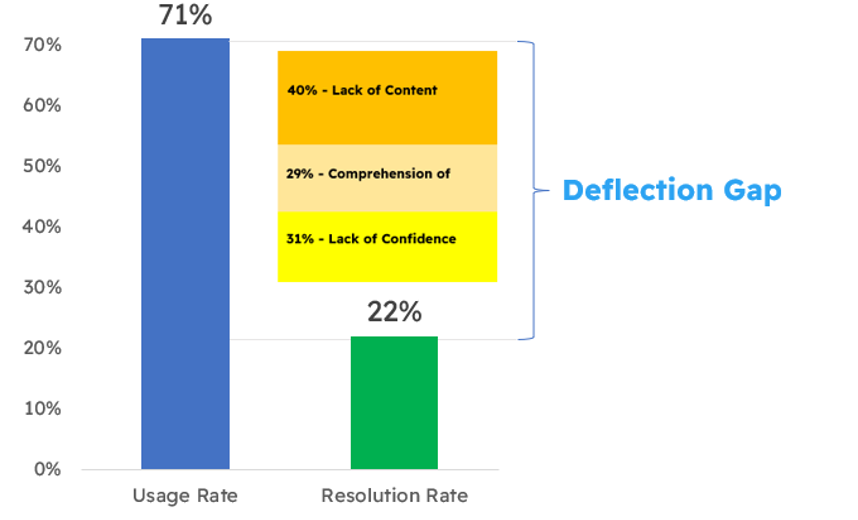
Customers use self-services, yet too often, resolution of issues remains elusive. ServiceXRG defines this underperformance of self-service resources as the Deflection Gap.
The Deflection Gap is the difference between the Usage Rate of self-service resources and the Resolution Rate of issues solved without direct support from assisted resources.
There are three primary reasons for the Deflection Gap:
- Lack of Content.
- Customer Comprehension of Content found.
- Lack of Confidence in the content offered.
This article examines steps necessary to close the Deflection Gap by addressing the Lack of Content.
Reasons for Content Gaps
Lack of content is the most common reason self-service resources do not fully resolve customer issues. Lack of content does not always mean the content does not exist. In some cases, gaps exist because content cannot be found or recognized as the answer.
Content Does not Exist
The content necessary to answer a customer question does not exist within the knowledge base or other self-help repositories such as self-paced training, communities, video, etc.
There is a gap between what customers want to know and what content has been created to respond to that specific customer need.
Identifying gaps in knowledge coverage can reduce this deficiency.
Content Cannot be Found
The content may exist but cannot be easily found by a customer.
This occurs when search and discovery tools lack the necessary precision to recall resources that are related to a customer’s need, or answers are in disparate knowledge repositories.
Powerful search with intuitive natural language query support and federated knowledge repositories can reduce this deficiency.
Content Not Recognized as the Answer
The content exists but is not recognized by the customer as the solution to their answer.
Customers may look for a specific answer to their question but may skip over relevant information if it is embedded in long, complex articles or buried deep within user guides or training resources.
Surfacing answers to specific questions in concise articles or videos can reduce this deficiency.
Identifying Content Gaps
Content gaps are identifiable when there is a clear customer need and no supporting self-service content available to respond. The following methods can be used to identify content gaps:
Topic Classification
Organize knowledge needs expressed by customers within common categories.
Develop a taxonomy to organize content by product feature, customer use case, or any other category to express a customer need or outcome.
Evaluate the extent of knowledge coverage for key categories customers ask about.
Query logs
Review the terms customers use to search for content. Determine if matching documents are found.
Consider if the reason for a content gap is due to missing content or inability to find information.
Take corrective action to develop content and/or improve search effectiveness.
Case Topic Analysis
Analyze the reasons for support cases to determine which if any could be resolved by self-help content.
Identify if content exists to provide a satisfactory answer to customers.
Community Discussions
Scan community forms to identify the topics that matter most to customers.
Community discussions hold a wealth of insight into what customers are interested in and where they may have issues using your product.
Prioritize
Prioritize topic gaps based on volume of issues that may be resolved and/or the potential savings from increasing self-service effectiveness.
Close Content Gaps
Here are key steps to identify and close content gaps:
-
Analyze submitted customers cases, search logs, and community discussions to identify the top issues customers need help with.
-
Conduct analysis of knowledge assets to determine the extent of corresponding coverage of top customer needs.
-
Evaluate the reasons content gaps exist (missing content, not found, not recognized as the answer).
-
Prioritize topic gaps based on volume of issues that may be resolved and/or the potential savings from increasing self-service effectiveness.
For more insights and guidance on optimizing your customer support strategies contact ServiceXRG.